
Extremely fierce battles” are raging in parts of Ukraine as Kyiv’s forces continue their counter-offensive, the country’s deputy defence minister says.
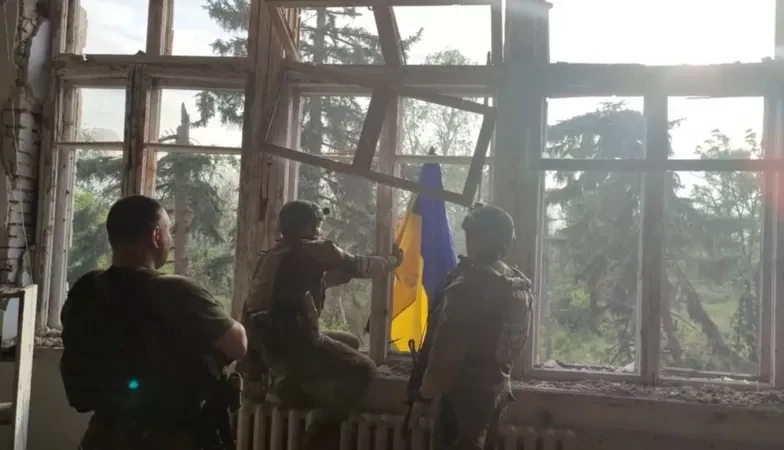
Hanna Maliar wrote on Telegram that Ukrainian forces had managed to advance near Bakhmut in the east and Zaporizhzhia in the south.
But she conceded Russian forces were mounting a stiff defence in some areas.
Her comments come after another night of Russian missile and drones strikes on cities across Ukraine.
Russia has stepped up its bombing campaign in recent weeks, despite President Vladimir Putin admitting that his forces are suffering from a shortage of missiles and drones. The latest wave included a relatively rare strike on the Black Sea port city of Odesa.
Kyiv’s much-anticipated advance has been long in the making, and Ukrainian officials have accused Russia of increasing strikes in recent weeks to deflect attention from the offensive.
The Ukrainians say their troops have recaptured seven settlements and at least 90 sq km (35 sq miles) since starting their counter-offensive.
Ms Maliar wrote on Telegram that Ukrainian troops had advanced around the city of Bakhmut, long the centre of a grinding and bloody street-by-street battle with Russian forces.
She said soldiers advanced by 200m to 500m towards the city, as well as advancing 300m to 500m in the southern Zaporizhzhia province. The BBC cannot independently verify these claims.
But she conceded that the counter-offensive had already led to some “extremely fierce battles”, as Ukrainian forces try to break through well established Russian defensive lines.
Senior Western officials have warned against the idea that Russian forces will simply “melt away” in the face of Ukrainian attacks, adding that Kyiv’s gains had already been “costly”.
“Russian forces have generally put up a good defence from their well-prepared, defended positions and had been falling back between tactical lines,” the sources said.
“This ‘manoeuvre defence approach’ is proving challenging for the Ukrainians and also costly to attacking forces. Hence, the advance at the moment has been slow,” they observed, adding that it was too soon to say how effective Ukraine’s offensive has been.
But they emphasised that heavy losses were to be expected, given Russia has had months to prepare defensive lines.
“This was never going to be without risk,” they said. “What we’re seeing is not unexpected. It’s difficult, and it is going to be challenging for Ukrainians. What we have seen, though, is they’ve continued to push through where they have had losses, and then continued to advance. So overall is going in the right direction.”
Both sides have reported mounting casualties among their opponents which cannot be independently verified.
Wednesday night’s strikes on the Black Sea port city of Odesa killed at east three people, Ukrainian officials have said.
Another 13 people were injured in the early morning attacks, which targeted a warehouse and damaged shops.
The south-western city is vital to Ukraine’s grain exports through the Black Sea and has come under infrequent missile fire during the war.
Military commanders said Russia fired 10 missiles and 10 drones overnight, most of which were shot down by air defences.
They added that three of four KH-22 missiles launched from a Russian warship in the Black Sea were shot down, with the final one managing to hit Odesa.
Oleg Kiper, the head of the region’s military administration, said the three dead were workers in the warehouse, which was being used as a food storage centre.
“There may be people under the rubble,” he added. More civilians were injured after the blast and “air combat” damaged shops, restaurants – including a McDonald’s – and residential areas, Mr Kiper wrote on Telegram.