
BY OUR CORRESPONDENT
The House of Representatives has mandated its relevant committees to investigate financial interventions in the power sector amounting to trillion of naira.
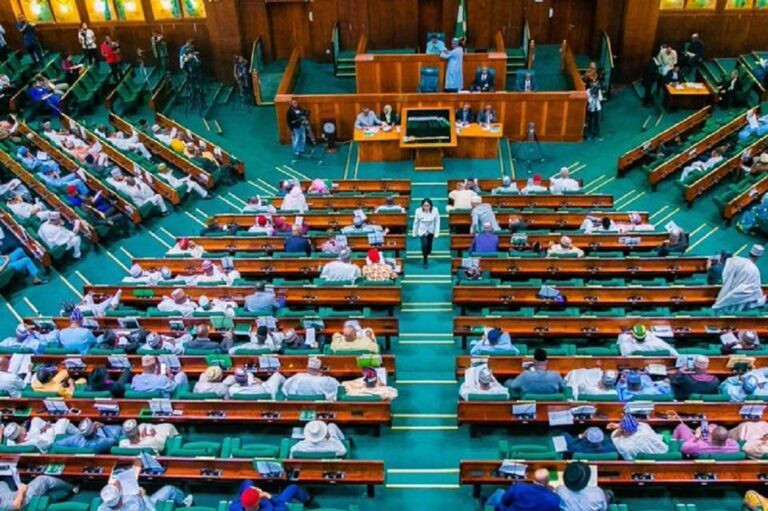
Adopting the motion of Hon. Ademorin Kuye, representing Shomolu Federal Constituency of Lagos State, the House mandated its committees on Power, Finance and Privatization and Commercialization to investigate all the financial interventions in the power sector since privatisation with a view to determine whether the funds were judiciously utilised or not.
Presenting the motion on Wednesday Hon. Kuye who is the House Committee Chairman on Public Assets noted that the Federal Government in 2013 unbundled the Power Holding Company of Nigeria,
(PHCN), and sold 18 utility firms to private investors resulting in six generation companies (GenCos)
and eleven distribution companies (DisCos);
“Also notes that the privatisation of Nigeria’s power sector was necessary due to the failure of the defunct
Power Holding Company to attract investments, but the industry did not meet Nigerians expectation;
“Observes that the Federal Government has spent over seven trillion Naira on direct interventions in the
power sector, despite privatizing the industry since November 2013. This includes the Presidential
Power Initiative, a strategic approach to address Nigeria’s unreliable and inadequate electricity supply;
“Also observes that if not for the interventions by the Central Bank of Nigeria (CBN) of over N1.3
trillion, Nigerian power would have collapsed due to liquidity, poor performance, suppressed tariffs
and lack of infrastructure at the transmission and distribution ends, weak regulations and oversight;
“Aware that since the privatization, the power sector has undergone various financial interventions,
including those from International Donor Agencies:
“(i)
the World Bank which approved an International Development Association (IDA) credit of the
sum of $486 million aimed at upgrading the wheeling capacity of the Nigerian electricity
transmission grid, including the rehabilitation and expansion of transmission substations across
Nigeria;
“(ii)
the African Development Bank (AFDB) provide a facility of the sum of $300 million to the TCN
for the purpose of expansion and rehabilitation of existing northern corridor transmission lines
particularly in the north-west and north-central regions;
“(iii) the French Development Agency provided facility of $170 million for Transmission
infrastructure expansion around Abuja metropolis and neighbouring States;
(iv) Japan International Cooperation Agency (JICA) provided a facility of $238 million for
Transmission infrastructure expansion within the southwest region of Nigeria;
“(v)
Japan International Cooperation Agency (JICA) provided a facility of $13 million for power
improvement along Apo and Keffi in Nasarawa State, northcentral Nigeria;
“(vi) Japan International Cooperation Agency (JICA) also again provided a facility of $21 million for
the Rehabilitation and upgrade of Apapa road 132KV substation and rehabilitation of Akangba
330KV substation;
“(vii) European Union (EU) provided facility of €25 million for electricity transmission infrastructure
along the northern corridor, particularly around the north-west and north-central regions of
Nigeria etc;
“Others include the German government, the UK’s Department for International Development, and
Siemens Energy are among the various agencies which have provided financial support for some projects,” he said .
He said that the revenue generation and collection have been the major challenge of the power sector
in that the DisCos laments over revenue shortfalls attributed to low electricity tariff or that electricity
revenue may be accruing to the wrong accounts;
“Also concerned that out of the eleven DisCos in Nigeria, banks have taken over six which are AEDC,
KADECO, KEDCO, BEDC, IBEDC and PHEDC due to poor financial performance and management;
Aware that the Aggregate Technical and Commercial Collection (ATC&C) loss is an actual measure
of the performance of a power distribution system as it includes both technical losses and commercial
losses. It shows the gap between input energy into the system and the units for which the payment is
collected;
“Informed that improved ATC&C loss reduction would be achieved if Discos adopted a combination of
other strategies that would ensure reduction in technical and commercial losses in addition to
aggressive deployment of meter assets;
Concerned that the Nigeria Electricity Regulatory Commission (NERC)’s performance as an industry
regulator is questioned for its ability to move the industry forward and eliminate illiquidity;
“Disturbed that the Nigeria Electricity Supply Industry faces threat due to the poor performance and
transparency of DISCOs and the NERC’s ability to sanction erring stakeholders;
Also worried that the National Power Grid has collapsed over seven times this year, despite the huge
investment in the power sector which explains the persistent electricity shortage in the country,” Kuye said
He added that a reliable electricity supply will significantly enhance living standards by promoting job
creation and stimulating other economic sectors like commerce and industries.
The Speaker of the House of Representatives, Rt. Tajudeen Abbas, referred the motion to House Committees on Power, Finance and Privatization and Commercialization for further legislative actions. The committees have six weeks to carry out the investigation and report back to the House.