
Israel killed Hezbollah leader Sayyed Hassan Nasrallah in a powerful airstrike in Beirut, dealing a huge blow to the Iran-backed group as it reels from an escalating campaign of Israeli attacks.
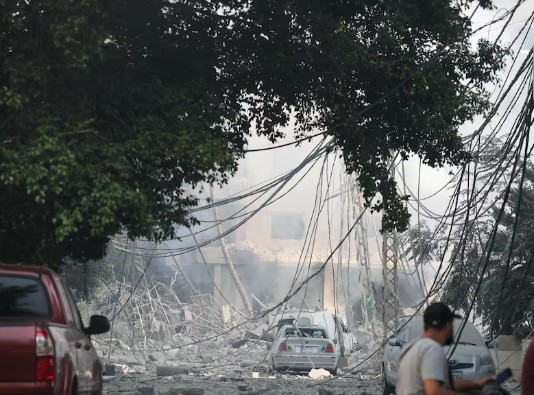
The Israeli military said on Saturday it had eliminated Nasrallah in the strike on the group’s central command headquarters in Beirut’s southern suburbs on Friday. Hezbollah confirmed he had been killed, without saying how.
Nasrallah led Hezbollah for 32 years.
His death is not only a major blow to Hezbollah, but also to Iran, removing an influential ally who helped build Hezbollah into the linchpin of Tehran’s constellation of allied groups in the Arab world.
A senior member of Iran’s Revolutionary Guards, deputy commander Abbas Nilforoushan, was also killed in the Israeli attacks in Beirut, Iranian media reported on Saturday.
Hezbollah’s announcement of his death Friday triggered tears and celebrations across the Arab world, pointing to the widespread reach and influence of a divisive man who has been at the forefront of Middle Eastern politics for decades.
The 64-year-old Nasrallah headed arguably the most powerful paramilitary force in the world — also a U.S.-designated terror organization.
“Nasrallah’s killing is a significant setback for Hezbollah, not only because of the pivotal role he played in Hezbollah’s strategy but also because his elimination reveals the extent of the group’s vulnerability vis-à-vis Israel,” said Lina Khatib, an associate fellow at Chatham House, an international affairs think tank.
“This will shake the confidence of Hezbollah’s Iran-backed allies across the Arab world, from the Houthis in Yemen to the Popular Mobilization Forces in Iraq, as well as Iran itself, sparking a tectonic shift in Iran’s network of influence in the Middle East,” she added.
It is not the first time Israel has killed a Hezbollah leader. Nasrallah took over from Abbas Mousawi, who was killed by an Israeli helicopter attack in 1992.
But Hezbollah today is very different from the ragtag organization it was in the ’90s. In recent years, he has presided over an army-like group estimated to have tens of thousands of fighters and a sophisticated arsenal capable of reaching anywhere inside Israel.
It has become the chief part of a cluster of Iranian-backed factions and governments of the self-named “Axis of Resistance.”
Strikes continued on Beirut’s southern suburbs throughout the early evening on Saturday, according to a Reuters live broadcast, sending large clouds of smoke over the city.
In Israel, air raid sirens sounded across the centre of the country on Saturday – including Tel Aviv – and large bangs were heard after a missile was fired from Yemen and intercepted, according to the Israeli military.
Hezbollah and Israel have been fighting a conflict in parallel with Israel’s war against Palestinian group Hamas in Gaza since Hamas’ attack on southern Israel last Oct. 7, a conflict that has sharply escalated in recent days.
Friday’s airstrike – a succession of massively powerful blasts that left a crater at least 20 metres (65 feet) deep – shook Beirut.
The Israeli military said Nasrallah was eliminated in a “targeted strike” on the group’s underground headquarters beneath a residential building in Dahiyeh – a Hezbollah-controlled southern suburb of Beirut.
It said he was killed along with another top Hezbollah leader, Ali Karaki, and other commanders.
“The strike was conducted while Hezbollah’s senior chain of command were operating from the headquarters and advancing terrorist activities against (Israeli) citizens”, it said.
Nasrallah’s death is by far the most significant blow in a devastating fortnight for Hezbollah, starting with a deadly attack on thousands of wireless communications devices used by its members.
Days later, Israel significantly ramped up airstrikes in Lebanon, killing several top Hezbollah commanders and hundreds of other people across wide areas of the country.
The escalation has increased fears the conflict could spin out of control, potentially drawing in Iran, Hezbollah’s principal backer, as well as the United States.
Iran’s dilemma
In his first remarks Saturday following Nasrallah’s death, Iran’s supreme leader gave no indication of how Tehran will respond.
In a vague statement, Supreme Leader Ayatollah Ali Khamenei said, “all regional resistance forces” support and stand beside Hezbollah, but he did not elaborate.
Iran is the main backer of Hezbollah and other anti-Israeli militant groups in the region, but it has largely avoided clashing directly with Israel due to domestic considerations.
Hezbollah, however, is Iran’s chief ally and proxy group, and Tehran may have to respond to retain its credibility with its partners in the axis.
The man widely regarded as his heir is Hashem Safieddine, a cousin of Nasrallah who oversees the group’s political affairs. It is not known if he survived Friday’s attack, and the Hezbollah statement announcing Nasrallah’s death Friday made no mention of a successor.
In just over 10 days, the Iran-backed group has been hit by a series of devastating attacks that dealt a severe blow to its military structure and exposed deep intelligence failures.
Any new Hezbollah leader will also have to contend with rising resentment and frustration among a significant section of the Lebanese population. For years, critics say, Hezbollah deprived Lebanon of its sovereignty by behaving as a state within a state and making unilateral decisions involving war and peace.
Many Christians and Sunnis, as well as a portion of the Shiite community, are opposed to the war and what they regard as Nasrallah’s unilateral decision to attack Israel in support of the Gaza front on Oct. 8, a day after the Hamas attack on Israel that ignited the war in the Palestinian territory.
Israeli Defence Minister Yoav Gallant said Israel’s war was not with the Lebanese people, calling Nasrallah the “murderer of thousands of Israelis and foreign citizens”.
Hezbollah has been waging hostilities with Israel since the eruption of the Gaza war a year ago, when it opened fire declaring solidarity with its Palestinian ally Hamas.
Speaking with Gallant on Friday, U.S. Defense Secretary Lloyd Austin said the U.S. was committed to Israel’s defence and determined to prevent Iran or its allies from exploiting the situation, a Pentagon statement said.
(Reuters/AP)