
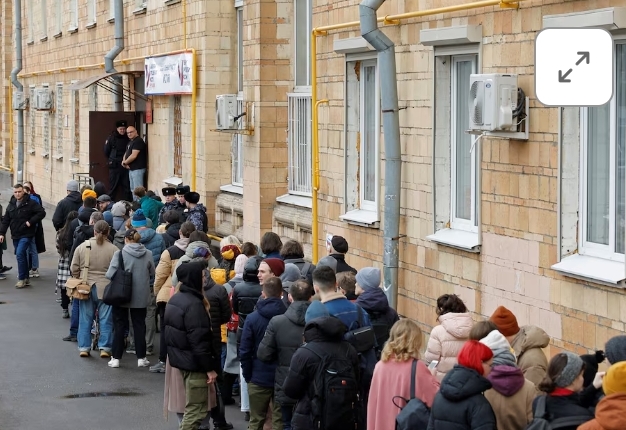
Thousands of people turned up at polling stations across Russia on Sunday to take part in what the anti-Kremlin opposition said was a peaceful but symbolic political protest against the re-election of President Vladimir Putin.
From a lowly KGB colonel to former Russian President Boris Yeltsin’s right-hand man and successor, the tale of Vladimir Putin’s rise to power is second only to his extraordinary reign.
Putin has served either as president or prime minister for nearly a quarter of a century – making him the longest-serving leader in modern Russian history since Soviet dictator Joseph Stalin.
In the year 2000, a 47-year-old Vladimir Putin was sworn in as president of Russia.
Since then, he’s been inaugurated four more times, and is on course to win his fifth term in office today, keeping him in power until at least 2030.
He spent four years as prime minister from 2008 due to a two-term limit imposed by the Russian constitution, during which time he installed Dmitry Medvedev – now chairman of Russia’s security council – as president.
Despite earlier promises to the contrary, in 2020, Putin changed these rules to give himself a clean slate to run again in 2024 by “switching back to zero” his previous terms.
At the time, opposition figures denounced the vote, saying he was aiming to be “president for life”.
Indeed, the revised term limit means Putin could run again in 2030. By the end of that six-year term, he would be 84.
I
Others had vowed to scrawl the name of late opposition leader Alexei Navalny, who died last month in an Arctic prison, on their voting slip.
Navalny’s allies broadcast videos on YouTube of lines of people queuing up at different polling stations across Russia at midday who they said were there to peacefully protest.
Navalny had endorsed the “Noon against Putin” plan in a message on social media facilitated by his lawyers before he died. The independent Novaya Gazeta newspaper called the planned action “Navalny’s political testament”.
“There is very little hope but if you can do something (like this) you should do it. There is nothing left of democracy,” one young woman, who did not give her name and whose face was blurred out by Navalny’s team, said at one polling station.
Another young woman at a different polling station, whose identity had been disguised in the same way, said she had voted for the “least dubious” of the three candidates running against Putin.
A male student voting in Moscow told Navalny’s channel that people like him who disagreed with the current system needed to go on living their lives regardless.
“History has shown that changes occur at the most unexpected of times,” he said.
Despite the protesters – who represent a small fraction of Russia’s 114 million voters – Putin is poised to tighten his grip on power in the election that is certain to deliver him a big victory.
With Russia’s vast landmass stretching across 11 time zones, protest voters were scattered rather than concentrated into a single mass, making it hard to estimate how many people turned up for the protest event.
The size of the queues at each polling station shown on Navalny’s channel ranged from a few dozen people to what looked like several hundred people.
Reuters journalists saw a slight increase in the flow of voters, especially younger people, at noon at some polling stations in Moscow and Yekaterinburg, with queues of several hundred people, and in some places even thousands.
Some said they were protesting though there were few outward signs to distinguish them from ordinary voters.
Leonid Volkov, an exiled Navalny aide who was attacked with a hammer last week in Vilnius, estimated hundreds of thousands of people had come out to polling stations in Moscow, St Petersburg, Yekaterinburg and other cities.
At polling stations at Russian diplomatic missions in Australia, Japan, Armenia, Kazakhstan, Germany, Britain, hundreds of Russians stood in line at noon.
In Berlin, Yulia, Navalny’s widow, showed up at the Russian embassy to take part in the protest event there along with Kira Yarmysh, Navalny’s spokesperson. Other Russians present clapped and chanted her name.
In London, thousands queued in near silence to vote at the Russian embassy.
“We haven’t been heard for past 30 years. Nobody listened to us. We moved, we emigrated, and even here, far away from Russia, we feel the consequences of not us not being heard,” said voter Natalia Cherednikova.
“This year is so important just to be there for ourselves, even though we all (are) …fatalistic in terms of the meaning of it and that nobody really cares. It’s just for ourselves that we’ve been here. We have voted. We showed up.”