
Cardinal Robert Prevost, a long-time missionary in Latin America, was elected as the surprise choice to be the new leader of the Catholic Church on Thursday, becoming the first U.S. pope and taking the name Leo XIV.
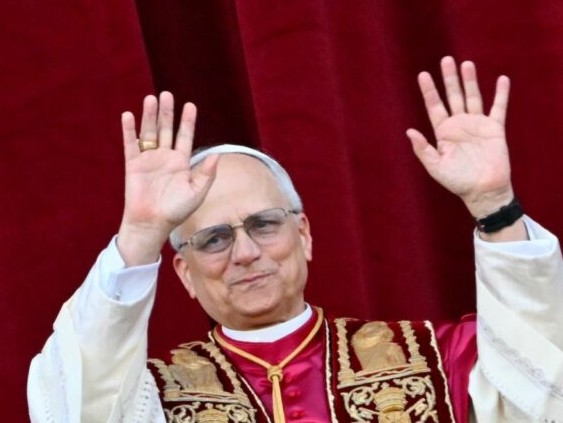
Pope Leo appeared on the central balcony of St. Peter’s Basilica after white smoke billowed from a chimney atop the Sistine Chapel, signifying the 133 cardinal electors had chosen him as a successor to Francis, who died last month.
“Peace be with you all,” he told the cheering crowd, speaking in fluent Italian. He also spoke in Spanish during his brief address but did not say anything in English.
Prevost, 69 and originally from Chicago, has spent most of his career as a missionary in Peru and has dual Peruvian nationality. He became a cardinal only in 2023. He has given few media interviews and is known to have a shy personality.
The old parish church buildings on Chicago’s far South Side where Pope Leo XIV grew up, attended grammar school and launched his career as a priest are now vacated and in disrepair, a victim of the sometimes painful changes within the Roman Catholic Church since he was a boy.
Even so, the derelict structures stand as a silent reminder to the new pontiff’s deep, longstanding ties to the city and the second-largest Catholic archdiocese in the United States.
Former Cardinal Robert Prevost stunned his hometown on Thursday when the Vatican announced that the 69-year-old Chicago native had been chosen as the first U.S.-born pontiff in the 2,000-year history of the Catholic Church.
His selection unleashed celebration among Catholics in the Midwestern city and a flurry of questions about the future of his papacy, from how it would shape the divide between church conservatives and liberals to whether he was a fan of the Chicago Cubs or their rivals, the White Sox.
“For Catholics in Chicago, this is somebody who gets us, who knows us, who knows our experience, seeing the closures and the dwindling congregations, and the diminishing Catholic presence in America in general,” said Father Michael Pfleger, a priest at St. Sabina Catholic Church on Chicago’s South Side known for his political activism.
A crowd of clergy and staff members at the Catholic Theological Union in Chicago’s Hyde Park, where the future pontiff obtained his master’s degree in divinity in 1982, erupted in joyful cheers as live television showed Pope Leo walking out onto the Vatican balcony in Rome.
“Many of us were just simply incredulous and just couldn’t even find words to express our delight, our pride,” said Sister Barbara Reid, the president of the theology school. She said the “explosion of excitement” was followed by quiet as the room fell into prayer for the new pope.
Reid described Pope Leo as a brilliant intellectual and a person of extraordinary compassion.
“It’s an unusual blend that makes him a leader who can think critically, but listens to the cries of the poorest, and always has in mind those who are most needy,” she said.
Lawrence Sullivan, the vicar general for the Archdiocese of Chicago, its 1.9 million Catholics and 216 parishes, said Pope Leo was also a very prayerful and spiritual man.
“It’s a day of great excitement for Chicago, for the United States to have one of our own be elected as the pope,” he said.
Chicago Mayor Brandon Johnson, in remarks posted on social media, was more plain-spoken in his exuberance, declaring: “Everything dope, including the Pope, comes from Chicago!”
The pope-to-be, by all accounts an exceptional student as a youngster, grew up in the old St. Mary of Assumption parish at the far southern edge of Chicago, attending grade school there and serving as an altar boy.
He later studied at the novitiate of the Order of Saint Augustine in St. Louis, according to the Catholic Conference of Illinois, before graduating from Villanova University near Philadelphia in 1977 with a degree in mathematics.
He then returned to Chicago to attend divinity school and joined the Augustinian religious order. When he was newly ordained he celebrated mass in his home parish, St. Mary of the Assumption. Since then he has spent the majority of his career overseas, mainly in Peru.
His family’s parish, situated in a leafy area on the far South Side near the Little Calumet River, has long been shuttered, tattered curtains fluttering in the red brick building’s shattered windows. Blocks of clapboard houses and Protestant churches surrounding the church – which closed when the archdiocese consolidated parishes – were quiet on Thursday afternoon.
Reuters